
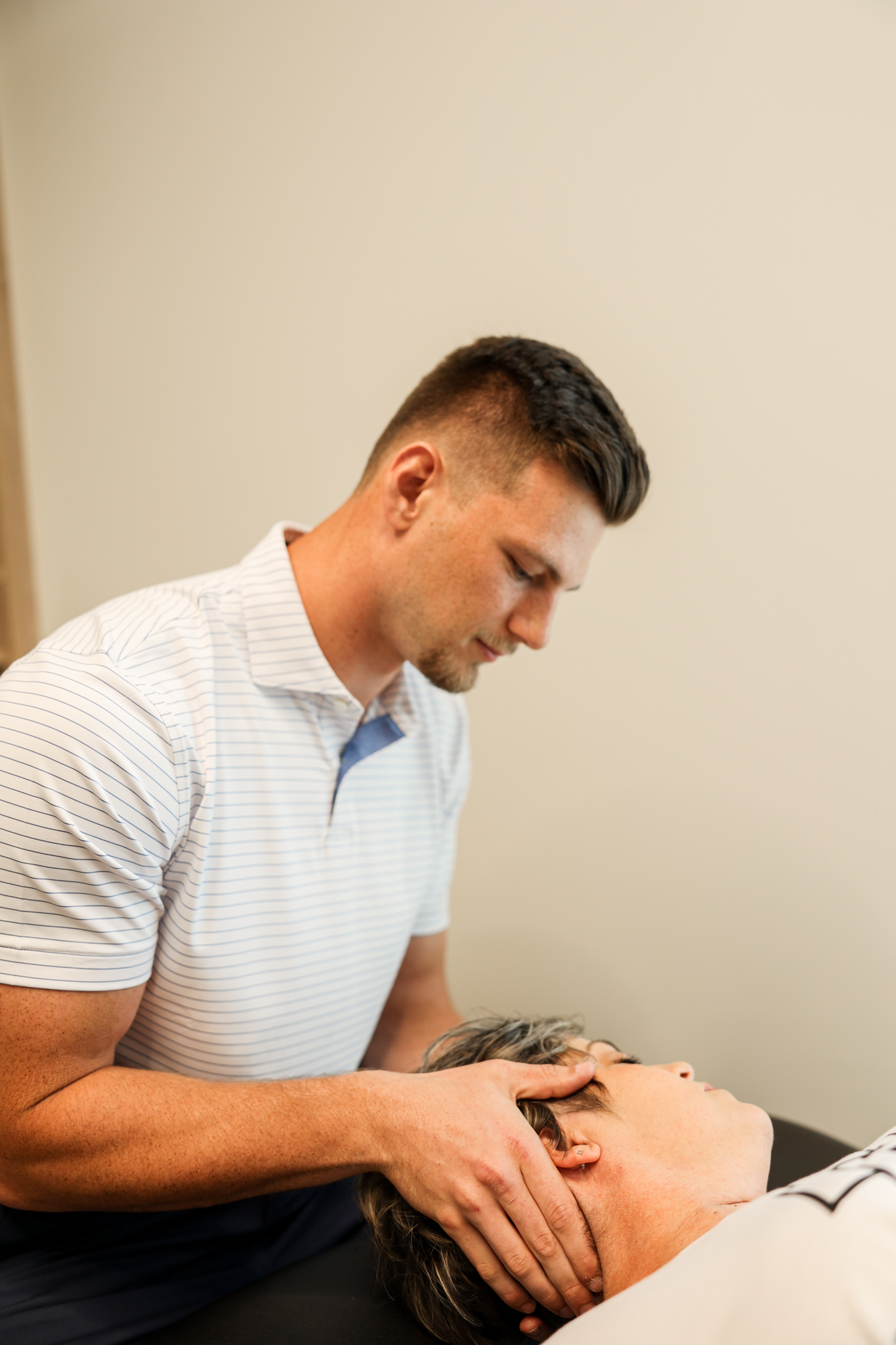
If you are a golfer dealing with stiffness, inconsistency, loss of distance, or even neck and shoulder tension during your swing, the problem may not be where you think it is.
One of the most overlooked pieces of the golf swing is cervical rotation — your ability to rotate your neck efficiently.
At Highland Spine and Sport, we commonly see golfers focusing heavily on shoulder mobility, thoracic rotation, and hip mobility while completely ignoring the cervical spine. But your neck plays a major role in how your body organizes movement throughout the entire swing.
The golf swing is a full body chain reaction.
If one area loses mobility, another area has to compensate.
Your cervical spine helps:
When cervical rotation is limited, golfers often compensate by:
In many cases, improving cervical mobility can immediately make the swing feel smoother and more connected.
Think of your body like a chain.
If one link becomes stiff, the entire chain changes how it moves.
The neck is often the hidden “kink in the chain” that disrupts movement quality throughout the golf swing.
Many golfers spend hours working on:
But if the cervical spine cannot rotate properly, the body may never fully access those improvements.
That is why at Highland Spine + Sport we look at the entire movement system instead of chasing symptoms alone.
You may benefit from addressing cervical mobility if you:
These limitations can impact both performance and comfort on the course.
As a TPI Certified provider, Highland Spine and Sport evaluates the entire body to identify movement restrictions that may be impacting your swing.
Treatment may include:
The goal is not just temporary relief.
The goal is helping your body move more efficiently so you can play golf longer, stronger, and with less pain.
Your golf swing is only as efficient as the body controlling it.
Sometimes the missing piece is not your hips, shoulders, or swing mechanics.
Sometimes the secret link in the chain is your neck.
Improving cervical rotation can help unlock smoother movement, better sequencing, improved comfort, and more efficient rotation throughout your swing.
If your body is limiting your golf game, it may be time to stop chasing symptoms and start addressing the root cause.